
Authors
Mark Mamenko, Sviatoslav Pavlenko, Denys Ilienko, Kateryna Shozda, Dmytro Poshytnyuk
Abstract
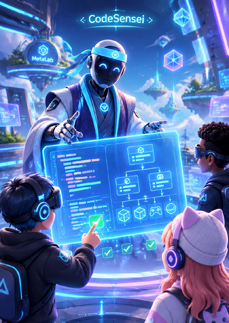
Development of an AI assistant called “CodeSensei” in the form of an NPC for integration intothe department’s virtual educational laboratory (MetaLab) on the VRChat platform. Studentswill be able to interact with the NPC through a virtual terminal, receiving explanations of objectorientedprogramming concepts, assistance with code writing, and instant feedback directlywithin the VR environment.
The CodeSensei project is developed as an intelligent application for integration into theVRChat Metaverse environment, complementing the virtual model of the educationallaboratory.
The main problem addressed by the application is the lack of immediate feedback and mentorsupport during students’ independent practical work in a distance-learning format. CodeSenseiacts as a virtual assistant capable of analyzing code snippets submitted through an in-gameterminal, identifying syntax errors, and explaining complex engineering concepts.
The application architecture consists of two key components. The client-side component isbased on VRChat SDK3 and UdonSharp (C#) and is responsible for the user interface (UIterminal), text input processing, and sending asynchronous HTTP requests. The server-sidecomponent (backend) is developed using .NET Core in accordance with Clean Architectureprinciples. The backend acts as a secure proxy server: it receives requests from VRChat,constructs the appropriate context (system prompts), communicates with the OpenAI API, andreturns the result to the client without exposing API keys within the game client. To ensure highperformance when processing large volumes of text (lines of code) on the server, optimizedmemory structures is used.
license
Creative Commons BY-SA 4.0
Language
English
Year of publication
2026
price
FREE
Learning materials
other sources - mind map
created with support of

Co-funded by the European Union. The views and opinions expressed are those of the authors and do not necessarily reflect those of the European Union or the Czech National Agency for International Education and Research. Neither the European Union nor the grant provider is responsible for them.