
Authors
Adityabaan Tripathy, Shubhayu Kundu
Abstract
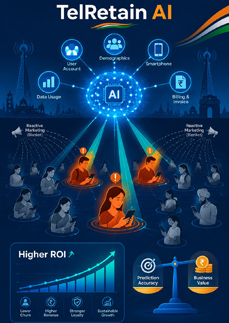
TelRetain AI is a data-driven proof of concept for anticipating customer churn in the Indiantelecommunications market and evaluating targeted retention activity. It responds to the team’sview that operators often use reactive, blanket marketing only after subscribers have decidedto leave. The project instead analyses account, demographic, device, usage and billing recordsto identify at-risk subscribers earlier, allowing an operator to consider selective interventions.Its business framing combines churn classification with a simulated return-on-investmentassessment rather than treating predictive accuracy as the sole criterion.
The team worked with two CSV files, identified as client.csv and record.csv, from a consumerdataset described as released by Reliance Jio. The merged source comprised approximately100,000 subscribers and 98 features, combining account-level demographics and deviceinformation with usage and billing records. The cleaned target was reported as nearlybalanced: about 50,400 retained customers and 49,500 customers who churned. A laterspeaker said the records covered 2025.
The eight-stage pipeline loaded and merged the files, automatically detected the churn column,cleaned missing and categorical values through median imputation and label encoding, andremoved features exceeding a 95% uniqueness threshold. Data were divided through astratified 80/20 train-test split. SMOTE was applied only to training data, and all preprocessingwas fitted on the training partition before being applied to the test partition. These choices werepresented as protections against leakage, distorted class distributions and overfitting.
Before modelling, the team examined two proposed signals. “Hardware fatigue” associatedolder handsets with greater susceptibility to competitors’ upgrade offers, while “silentdeparture” treated a gradual decline in minutes of use and recharge activity as a possibleprecursor to churn. Box plots for both were generated in Google Colab. Random Forest andXGBoost classifiers were then trained and compared; XGBoost was selected after a slight performance advantage. The pipeline also scanned classification thresholds and fed predictedrisk segments into a financial simulation intended to estimate whether targeted retention couldcreate value.
license
Creative Commons BY-SA 4.0
Language
English
Year of publication
2026
price
FREE
Learning materials
other sources - mind map
created with support of

Co-funded by the European Union. The views and opinions expressed are those of the authors and do not necessarily reflect those of the European Union or the Czech National Agency for International Education and Research. Neither the European Union nor the grant provider is responsible for them.