
Authors
Ostap Krochak, Vira Poberezhnyk
Abstract
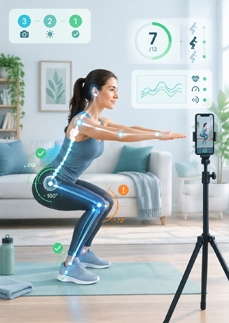
CROC.cv addresses the difficulty of performing physical rehabilitation exercises correctly athome without continuous clinical observation. It is a camera-based support system for patientsand doctors or rehabilitation clinics, combining automated movement tracking with clinicianoversight. Through solo training and live consultation modes, the concept aims to identifytechnique errors, count repetitions, provide immediate feedback, and give doctors progressinformation. The project emphasizes user control of sensitive data and avoiding storage of rawmedical video on the project server.
The workflow separates doctor and patient journeys behind authentication. In the doctordashboard, the prototype displays a patient list, built-in chat, profile progress statistics, and atraining programme from which an exercise—demonstrated with standing squats—can beassigned. A doctor creates a room and shares its unique code with the patient during an initialin-person consultation. After entering the code, the patient sees the assigned exercise andguidance on performance and camera positioning.
The central workflow is camera-based movement processing. A three-second setup periodallows positioning and lighting checks. MediaPipe locates joints, while the described pipelinehandles 33 three-dimensional skeleton points, timestamps and movement state. Geometricvector analysis, machine-learning filters and state machines are intended to recognisemovement phases, detect technical errors, provide visual feedback, count repetitions andproduce a telemetry report. Solo mode supports independent home training and subsequentreporting; live mode is designed as a secure video call in which the doctor sees a real-timeskeleton overlay.
Privacy is addressed through direct WebRTC peer-to-peer communication for chat and livesessions. The project server handles essential metadata, including names and authenticationstatus, rather than raw video. For user-managed files, the patient connects a private GoogleDrive folder, grants restricted doctor access, and controls sharing or revocation; the team saidvideo is encrypted client-side before cloud transfer. Patients can stop recording at any time.The system does not generate automated medical consultations, and its rehabilitationexercises remain associated with doctor assignment and review.
license
Creative Commons BY-SA 4.0
Language
English
Year of publication
2026
price
FREE
Learning materials
other sources - mind map
created with support of

Co-funded by the European Union. The views and opinions expressed are those of the authors and do not necessarily reflect those of the European Union or the Czech National Agency for International Education and Research. Neither the European Union nor the grant provider is responsible for them.