
Authors
Sofiia Mikhailova, Olena Mikhailova
Abstract
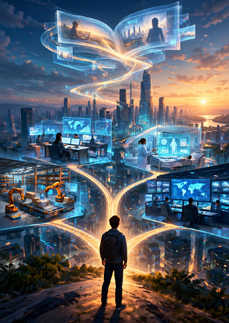
A Day in the Digital City explores how immersive simulation and AI-generated reflection canprepare people for digitally transformed work. It addresses two audiences: workers alreadyfacing automation, algorithmic decisions, monitoring, or unfamiliar AI tools; and peopleconsidering a move into a new profession without knowing its practical and emotionaldemands. Rather than scoring aptitude or diagnosing users, the proposed virtual city placesthem inside consequential workplace scenarios and returns a personalised narrative about thepattern of choices they made under pressure.
The experience is organised as a virtual city with five buildings, each containing a workerwhose occupation is being changed by technology. Presented situations included Maria, ateacher weighing an AI grading assistant against her own judgement when a scholarship is atstake; a project manager constrained by corporate AI policy; a warehouse worker whose 22years of experience are not recognised by the system managing him; and a remote designerwhose thinking is invisible to productivity-monitoring software. The team designed fivecharacters, fifteen decision points, and complete emotional arcs before coding.
Users enter through a headset or browser, select a building, and move into a character’s story.Each story contains three consequential decisions, with two response buttons at each decisionpoint. The three selections form a decision vector and structured prompt for a language model.Instead of issuing a mark or right-or-wrong judgement, the model generates a narrative describing what the choices suggest, the tension the user navigated, and a question to carryforward. Different choice combinations are intended to produce different reflections.The implemented scenario is the school story. In Unity, the team built a first-person 3Dclassroom with invisible trigger zones that activate dialogue. A Decision Manager script storesthe player’s selections; after the third choice, a Reflection Manager combines those selectionswith character context, sends the prompt to AI, and displays the returned reflection in thescene. During the presentation, the team generated a reflection for Maria and later ran theUnity build, moved through its stages, selected decisions, and reached the AI reflection. Theremaining buildings and richer interactions were described as planned rather than completed.
license
Creative Commons BY-SA 4.0
Language
English
Year of publication
2026
price
FREE
Learning materials
other sources - mind map
created with support of

Co-funded by the European Union. The views and opinions expressed are those of the authors and do not necessarily reflect those of the European Union or the Czech National Agency for International Education and Research. Neither the European Union nor the grant provider is responsible for them.