2.5
Handover operation
The mobile station always communicates with the nearest base station, or more precisely, with the station providing the strongest signal at the location of the mobile station. However, if a mobile station reaches the area of a neighboring cell during its movement, the ongoing connection is automatically switched to the base station of this neighboring cell.
Definition
This mode of operation is referred to as ”Handover" operation.
The handover is designed to manage changes to the user's current position with respect to their target position, which is caused by the user's movement across the cellular network structure. The main purpose of Handover in mobile networks is to ensure a continuous connection with a high Quality of Service (QoS) or so-called balance load in the network.
Tracking the location of mobile stations in the network ensures that a connection between the mobile and base stations is constantly established automatically. This information is also registered in the mobile network, which allows the connection to called subscriber to be routed directly to the area where the station is most likely to be located.
Interesting
In neighboring cells, communication channels with different frequencies are always used based on frequency planning. When a mobile subscriber crosses a border between two different cells, it is always necessary to return to its mobile station.
+
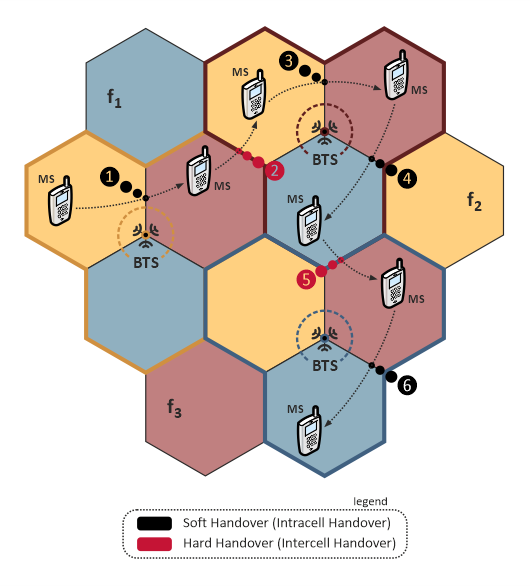
Fig. 7 Handover principle.
In mobile networks, however, two types of “Handover" can be distinguished in terms of the actual operation of the network:
- Intercell Handover, respectively Hard Handover – if Hard Handover is used in the operation of the mobile network, then the mobile station MS first terminates all connections with the base station BTS that operated it. As soon as the connection to the original base station BTS is terminated, a new connection is established with the base station BTS2 that took over the service. Therefore, this type of handover is also known as "break-before-make", as there is a brief interruption between the communicating participants. The duration of the interruption during the transfer depends on the nature of the flow of control messages exchanged between the mobile station MS and the network. The length of the interruption also depends on other factors, such as the wireless technologies used (e.g. LTE or WiMAX (Worldwide Interoperability for Microwave Access), the length of the frame at the physical layer, or the current network load. In general, however, the length of interruptions in the mobile network is in the order of tens to hundreds of milliseconds.
- Intracell handover, respectively Soft Handover) – allows simultaneous connection and operation of the mobile station MS to several base stations at the same time. As a result, an automatic transfer is made without interruption, which would be observable by the user during the communication. This rewiring is also known as "make-before-break". Soft Handover can be implemented as MDHO (Macro Diversity HandOver) or FCS (Fast Cell Selection), which is also often referred to as FBSS (Fast Base Station Switching). In the case of MDHO, the macro diversity of signals received from several different base stations is realized, directly in the active set (in the WiMAX system, it is referred to as the sample reception set). A significant disadvantage of this approach is its high complexity and difficult implementation. In the case of FCS, the best-received frame transmitted simultaneously from all stations is selected and processed and then included in the active file. Although FCS switching is significantly easier compared to MDHO switching, it is still much more complex than Hard Handover. Therefore, Hard Handover is considered mandatory in cellular networks, while other types of handovers are optional.