4.1
Network virtualization and technologies that could be interchanged with each other
4.1.1
Network virtualization vs. software-defined networks
Network virtualization may evoke software-defined networking (SDN), but in reality they are very different concepts.
A software-defined network allows software management of switches and routers, so it does not virtualize all network components and functions.
+
![15. Diagram of a software-defined network [11]](image/small/img015.png)
Fig. 15. Diagram of a software-defined network [11]
In contrast, network virtualization replicates all network components and functions in the software. It allows you to run the entire network in software.
4.1.2
Network virtualization vs. VLAN
A VLAN (Virtual Local Area Network) divides a physical local area network (LAN) into multiple virtual networks. Groups of ports are isolated from each other as if they were on physically different networks. The VLAN access is like slicing a large network pie into many small networks. Looking forward as the network grows, the limitation to 4096 VLANs in a single LAN may be a limitation.
Network virtualization is much more than just VLANs and allows you to create entire networks in software - including switching, routing, firewalling and load balancing. This provides much more flexibility than has been possible in the past. With all networking and security services handled in software and connected to VMs, management- and configuration-intensive processes can be simplified and automated, with networks being created automatically to meet the requirements.
+
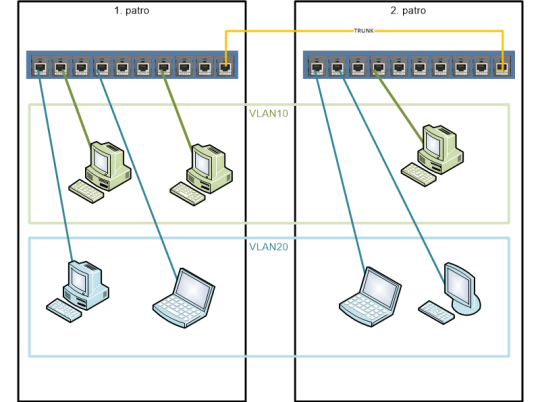
Fig. 16. Example VLAN
According to the IEEE 802.1Q recommendation, the virtual network identifier field (VLAN TAG) is inserted into the Ethernet frame . However, this extends the Ethernet frame by 4 bytes, which could indicate incompatibility with devices that do not support VLAN TAG. From a technical point of view, therefore, the switch must distinguish between two types of interfaces - access and trunk.