
Autoři
Sviatoslav Pavlenko, Denys Ilienko, Dmytro Poshytnyuk, Mark Mamenko, Kateryna Shozda
Anotace
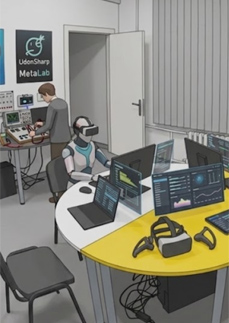
The project aims to develop an accurate virtual replica of the department’s educationallaboratory on the VRChat platform. The core idea is to transfer the physical educational space— including workstations, networking equipment, and 3D printers — into the Metaverse. Thiscreates a convenient environment for conducting remote laboratory sessions and enablingcollaborative work among students, providing a sense of real presence through modern VRtechnologies.
The MetaLab virtual laboratory is developed as a functional environment on the VRChatplatform. The project aims to accurately reproduce the working environment of softwareengineers and IT professionals. An important stage of the project is the creation of 3D modelscorresponding to the laboratory’s actual equipment, including semi-circular tables with whiteand-yellow zoning, workstations, 3D printers, oscilloscopes, and server equipment. The 3Dmodeling process includes optimization of details through retopology to reduce the number ofpolygons. This is necessary to ensure a stable frame rate (FPS) across different devices.Visual realism is achieved through the use of modern PBR (Physically Based Rendering)materials and static lighting (light baking) in the Unity game engine. This approach reduces thecomputational load on users’ devices. The interactive component of the environment isdeveloped using the built-in Udon framework. Using UdonSharp scripts (C#), the team createdfunctional elements such as virtual screens, equipment interaction mechanisms, and a triggersystem for educational tasks. As a result, the project provides not merely a visual scene, but aprepared platform for the future integration of educational software tools. This approach makesit possible to conduct full-fledged laboratory sessions in virtual reality without compromisingthe quality of education.
licence
Creative Commons BY-SA 4.0
Jazyk
anglicky
rok vzniku
2026
cena
ZDARMA
Výukové materiály
další zdroje - mind mapa
za finanční podpory

Financováno Evropskou unií. Vyjádřené názory a stanoviska představují názory a stanoviska autorů a nemusí nutně odrážet názory a stanoviska Evropské unie nebo Domu zahraniční spolupráce. Evropská unie ani poskytovatel grantu za ně nenesou odpovědnost.