
Autoři
Yasaman Alborz, Amirhossein Mohsenpour, Amirhossein Mohsen pour, Shayan Mansournia
Anotace
Knowledge Lens AI addresses enterprise compliance and knowledge-management problems caused by fragmented regulatory and internal documents. It is intended for banks, regulators, universities, and large organisations whose staff must locate current requirements, understand document relationships, and retain institutional knowledge when employees leave. The proposed platform combines retrieval-augmented generation with a knowledge graph to produce source-cited answers, visualise relationships, and flag apparent policy conflicts. Its emphasis is enterprise use, including sensitive repositories, rather than a consumer-facing assistant.
The presentation framed the project around three enterprise problems: slow access to archived documents, poor visibility of current versions and regulatory updates, and dependence on knowledge held by particular employees. These issues were discussed primarily in relation to banks and other regulated organisations, although universities and large enterprises were also identified as possible users. Knowledge Lens AI was therefore presented as a shared organisational knowledge layer rather than a tool for an individual consumer.
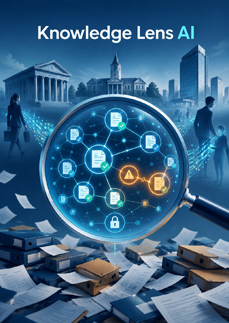
Its architecture combines retrieval-augmented generation with a knowledge graph and a conflict-reasoning layer. Ingestion begins with document collection, OCR or PDF-to-text conversion, semantic chunking, and embedding generation. The resulting vectors are stored and indexed for similarity-based retrieval. When a user asks a question, relevant sections are retrieved and passed to a GPT-based reasoning process. The generated response includes citations so that users can trace the answer to its documentary sources. The knowledge graph represents links between documents and records conflict edges when different documents appear to prescribe incompatible requirements.
The demonstrated dashboard accepted a question concerning the maximum loan-to-value ratio for a retail mortgage. It generated an answer, flagged a conflict between two documents, and displayed the relationship in a graph. Users could inspect nodes, metadata such as language and status, conflict severity categories, and indexed documents. The presenter also described conversational memory and real-time information analysis as platform features. The graph is designed to update incrementally when documents are added, rather than being rebuilt from the beginning.
licence
Creative Commons BY-SA 4.0
Jazyk
anglicky
rok vzniku
2026
cena
ZDARMA
Výukové materiály
další zdroje - mind mapa
za finanční podpory

Financováno Evropskou unií. Vyjádřené názory a stanoviska představují názory a stanoviska autorů a nemusí nutně odrážet názory a stanoviska Evropské unie nebo Domu zahraniční spolupráce. Evropská unie ani poskytovatel grantu za ně nenesou odpovědnost.