
Autoři
Maria Vodko, Oleksandra Zhurakovska, Hanna Chernobai, Daryna Vodko
Anotace
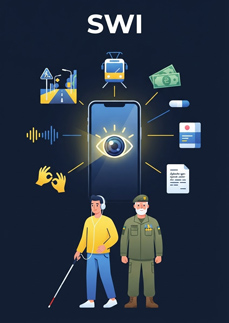
SWI is an accessibility-focused mobile application concept intended to give “digital eyes” toblind users through camera-based interpretation of their surroundings. Designed for theUkrainian context, it proposes combining object and street recognition, Ukrainian text reading,currency and medicine identification, public-transport detection, and spoken feedback. Thebroader concept also addresses communication access for deaf or hard-of-hearing peoplethrough sign-language translation and large on-screen text, while a veteran profile is intendedto support people adapting to sight loss and seeking greater independence.
The project arose after the team saw a blind man on TikTok who enjoyed walking outdoors butoften collided with obstacles. This example framed an everyday safety and independenceproblem. Hana analyzed the target audience and competitor applications to identify marketgaps. The team argued that global accessibility apps do not adequately recognize Ukrainianmoney, local medicines, or Ukrainian text, motivating a locally oriented concept thatconsolidates functions otherwise spread across several tools.
In the proposed experience, opening SWI activates the phone camera immediately. Theinterface is intended to interpret the view automatically, describe objects and the street aloud,read signs, and recognize relevant items without requiring the user to locate a scan button.Profiles would tailor the interaction for blind people, deaf people, or veterans. Gesture controlsreplace dependence on ordinary visual buttons: a tap repeats text, a long press opens thevoice assistant, and a swipe changes modes. Additional proposed functions include public transport detection, medicine reminders, sign-language-to-text or voice translation, and largetextdisplay.
The presentation included an interactive Figma prototype and a demonstration sequenceillustrating intended outputs: descriptions of a bed and decorative vase, a currency reading,and identification of a sterile bandage. In questioning, the team clarified that the material wasa design and video representation, not a working AI application. SWI therefore remains anidea-stage concept. Its technical analyst outlined a possible architecture, while softwareimplementation, model integration, internet behavior, and user validation remain future work.
licence
Creative Commons BY-SA 4.0
Jazyk
anglicky
rok vzniku
2026
cena
ZDARMA
Výukové materiály
další zdroje - mind mapa
za finanční podpory

Financováno Evropskou unií. Vyjádřené názory a stanoviska představují názory a stanoviska autorů a nemusí nutně odrážet názory a stanoviska Evropské unie nebo Domu zahraniční spolupráce. Evropská unie ani poskytovatel grantu za ně nenesou odpovědnost.