
Autoři
Pavlo Grebenyuk, Andrii Vizitiu, Maksym Shypilkin, Daria Skakun
Anotace
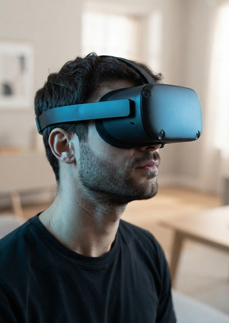
The project addresses the creation of a shared, multi-user virtual environment intended fordistributed learning, joint discussion and remote teamwork. It responds to a practical situationtypical of next-generation labour: teams that are geographically separated still need a commonspace in which they can meet, look at the same materials and act on the same objects, ratherthan exchanging files and speaking through a flat video window.The team designed and implemented a social VR space on the VRChat platform in whichseveral participants, joining either from a stand-alone VR headset or from an ordinary Androidsmartphone, are present at the same time as avatars. Inside the space they can talk to eachother, interact with objects and watch video materials together on a large virtual screen locatedin a custom-built room. The topic combines immersive technologies, collaborative digitalenvironments and cross-device accessibility.
The artifact is a complete VRChat world built in Unity with the VRChat Worlds SDK andpublished on the VRChat platform. Participants enter the world through the VRChat client,appear as avatars, and are able to move freely, speak using positional voice chat and seewhere the other participants are looking and pointing. The platform itself provides account management, matchmaking, networking and voice transport, which allowed the team toconcentrate on the design of the space and on the interaction inside it.
The central element of the world is a custom-designed room that serves as the main meetingand viewing area. It was modelled and assembled by the team rather than taken from anexisting template, and its layout — seating arrangement, sightlines, lighting and the placementof the screen — was organised around group viewing and discussion. A large virtual screenoccupies one wall of the room and plays video materials for everyone present: playback issynchronised across users, so that all participants see the same content at the same momentand can pause, comment and continue together. This turns the room into a space for joint workwith video material rather than a passive viewing environment.
The world also contains interactive objects. Objects can be picked up, moved and handled byparticipants, and elements placed in the room respond to user actions and can be used duringdemonstrations or joint activities. Because interaction is networked, the result of an actionperformed by one participant is visible to the others, which is what makes the space usable forshared tasks rather than for individual exploration.
Particular attention was paid to cross-platform compatibility. The world was built for the Androidtarget so that it runs natively on the stand-alone Meta Quest 3 headset and on the VRChatmobile client for Android devices. This imposed constraints on geometry, texture budgets,lighting and the number of dynamic objects, and required the team to optimise the scene andto verify performance on the actual devices instead of relying only on the editor. As a result,users with a headset receive a fully immersive experience, while users with only a smartphonecan join the same session and take part in the same discussion.
licence
Creative Commons BY-SA 4.0
Jazyk
anglicky
rok vzniku
2026
cena
ZDARMA
Výukové materiály
další zdroje - mind mapa
za finanční podpory

Financováno Evropskou unií. Vyjádřené názory a stanoviska představují názory a stanoviska autorů a nemusí nutně odrážet názory a stanoviska Evropské unie nebo Domu zahraniční spolupráce. Evropská unie ani poskytovatel grantu za ně nenesou odpovědnost.